
"Why bother?" Especially when it comes to a large problem like climate change with long-term effects laced with uncertainty that are difficult to predict or quantify and nearly impossible to internalize as just one human being and the feeling that nothing you do will ever make a measurable difference.
Like one lone dung beetle on an industrial cattle farm...you feel like this shit will never end.
Like one lone dung beetle on an industrial cattle farm...you feel like this shit will never end.

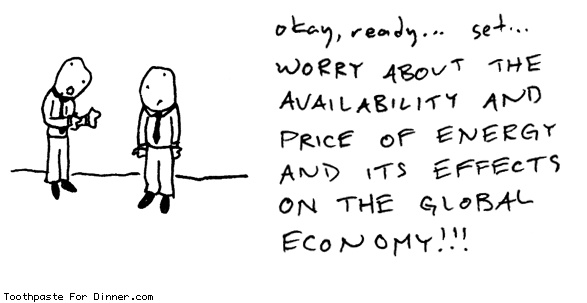
Psychologists argue that humans have a limited "bucket of worry" which we fill up with a set number of things. I may care about the environment in times of money and health, but when economic trouble arise this worry suddenly pushes the environment out of my consciousness. I can't be bothered to care about the environment when I'm short on rent or my stock portfolio is threatened.
 I like to compare it to world harmony and politeness. In no way do we believe that we can ease our worries about strife and violence in the entire world by doing little things to be polite, like saying "thank you" and giving up our seats for elderly people. But that's not the point.


The "drop in the bucket" theory adds its depressing weight by saying that humans often don't bother taking action because they see their efforts as simply a "drop in the bucket" (or one dung beetle, if you will) of a problem so large that it makes no difference. The bucket will be fine without my drop so who cares.
I admit I see some value in these lines of thinking. I can see how, evolutionarily, the bucket of worry made sure you stopped caring about your claw necklace when food was low. Or how the drop in the bucket prevented you from spending precious group resources on a useless cause.
I'm not even arguing that the environment should fill your bucket of worry, or that you owe it to the world to be the dung beetle.
What I'm arguing is that these buckets don't even apply to environmental action.
You don't try to reduce your carbon footprint because you are worried about the environment. That would be like trying to clean up the BP oil spill with a kitchen mop. No--what you're worried about it your own personal impact. You're taking ownership of the emissions associated with the services and items you purchase. Just like your understand your spending in dollars you understand it in carbon. Instead of inaction based on the hopeless world-view of a problem, you act because of your own intelligent understanding of impacts tied to what you do.
I like to compare it to world harmony and politeness. In no way do we believe that we can ease our worries about strife and violence in the entire world by doing little things to be polite, like saying "thank you" and giving up our seats for elderly people. But that's not the point. The point is that we try to own our actions, and the little things we do to be polite are worth it because they improve the immediate bubbles that are our lives. Of course no one's always polite, as you can see from the opening paragraph of this blog, but we can consider ourselves polite people as long as we do what we can.
This is essentially how we go through life. You don't have to believe you're working for world peace when you say "thank you" to your waiter. So how ridiculous is it to say that reducing your personal environmental impact isn't worthwhile just because it's not immediately affecting major global issues?
Honestly...if that's your test of validity, there's no bothering to do ANYTHING. I'm not getting out of bed today, because it's not going to solve problems of laziness in the world. Really now? Come on.
It's absurd that "why bother?" is even a legitimate question. The question I'm asking is "why on earth not?!" Just like minding your manners, managing your finances and generally respecting (reasonable) laws, keeping an eye on your footprint is just part of what you do.
NO ONE is perfect about their manners, money or minding every law [jaywalking..anyone?], but the point is we all try a good, decent amount. And I'd say about 80% of the time, 80% of people are doing a pretty decent job and we consider those people to be acceptable in society.
We don't all have to be heroes, it's just a matter of developing a new common sense. Sometimes you splurge on something expensive or sound like a angry trucker or eat a giant steak, but in general you can still call yourself a decent person who makes the effort. That in and of itself is worth a whole bunch of buckets because it's who you are.
Instead of calculating your impacts so that you can worry and feel like a bad person, I say that calculating your impacts gives you the opportunity to feel like a good person with a chance to make their own life-bubble better and more efficient. Of course large political and economic changes will be needed to solve the vast global environmental problems that we face, but what we each face on a daily basis is much more manageable. Beef or chicken? Car or walk? DVD or concert? "Thanks" or no thanks? That shit we can handle.

No comments:
Post a Comment